Heavy Equipment Operator
Heavy Equipment Operator
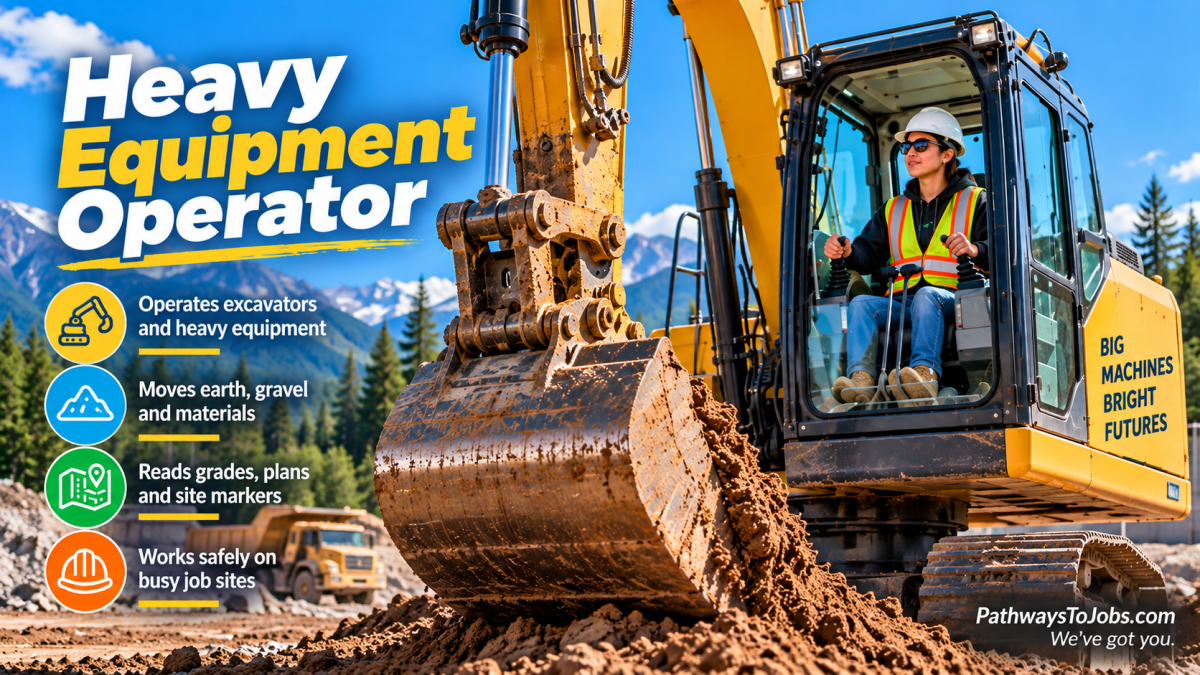
Career Overview
Heavy equipment operators operate and control machinery used to move earth, materials, and other heavy loads. They may work on construction and infrastructure projects, in mining and quarrying, or in other industries that require large machinery. Operators must understand their equipment, follow work plans and safety procedures, and work carefully around people, vehicles, and structures. * This career is eligible for Red Seal Certification in Canada.
Education
A high school diploma or equivalent can be a useful starting point, although requirements vary by occupation and location. Many operators develop their skills through hands-on training, apprenticeship programs, vocational education, or supervised experience. Training may cover equipment operation, maintenance, workplace safety, and reading site plans or instructions. Some types of equipment may require specific certification or licensing. "Red Seal eligible in designated heavy equipment operator trades"
Work Environment
Heavy equipment operators usually work outdoors on construction sites, roads, infrastructure projects, mines, quarries, or other large worksites. The work can involve changing weather, noise, dust, and long periods of operating machinery. Safety awareness, concentration, coordination, and good communication with other workers are important.
Future Outlook
Heavy equipment operators are likely to remain important as communities build and maintain roads, buildings, utilities, transportation systems, and other infrastructure. Newer equipment increasingly incorporates automation, GPS, digital controls, and other technologies, so operators who are comfortable learning new machinery and technology can be well prepared for the changing workplace.
Recommended High School Courses
- Math
- Communication
- Mechanics of Material
- Construction safety
- Physical fitness
- Active Listening - Giving full attention to what other people are saying, taking time to understand the points being made, asking questions as appropriate, and not interrupting at inappropriate times.
- Equipment Maintenance - Performing routine maintenance on equipment and determining when and what kind of maintenance is needed.
- Monitoring - Monitoring/Assessing performance of yourself, other individuals, or organizations to make improvements or take corrective action.
- Operation and Control - Controlling operations of equipment or systems.
- Operation Monitoring - Watching gauges, dials, or other indicators to make sure a machine is working properly.
- Time Management - Managing one's own time and the time of others.
- Troubleshooting - Determining causes of operating errors and deciding what to do about it.
- English Language - Knowledge of the structure and content of the English language including the meaning and spelling of words, rules of composition, and grammar.
- Mechanical - Knowledge of machines and tools, including their designs, uses, repair, and maintenance.
- Public Safety and Security - Knowledge of relevant equipment, policies, procedures, and strategies to promote effective local, state, or national security operations for the protection of people, data, property, and institutions.
- Arm-Hand Steadiness - The ability to keep your hand and arm steady while moving your arm or while holding your arm and hand in one position.
- Auditory Attention - The ability to focus on a single source of sound in the presence of other distracting sounds.
- Control Precision - The ability to quickly and repeatedly adjust the controls of a machine or a vehicle to exact positions.
- Deductive Reasoning - The ability to apply general rules to specific problems to produce answers that make sense.
- Depth Perception - The ability to judge which of several objects is closer or farther away from you, or to judge the distance between you and an object.
- Far Vision - The ability to see details at a distance.
- Finger Dexterity - The ability to make precisely coordinated movements of the fingers of one or both hands to grasp, manipulate, or assemble very small objects.
- Hearing Sensitivity - The ability to detect or tell the differences between sounds that vary in pitch and loudness.
- Inductive Reasoning - The ability to combine pieces of information to form general rules or conclusions (includes finding a relationship among seemingly unrelated events).
- Information Ordering - The ability to arrange things or actions in a certain order or pattern according to a specific rule or set of rules (e.g., patterns of numbers, letters, words, pictures, mathematical operations).
- Manual Dexterity - The ability to quickly move your hand, your hand together with your arm, or your two hands to grasp, manipulate, or assemble objects.
- Multilimb Coordination - The ability to coordinate two or more limbs (for example, two arms, two legs, or one leg and one arm) while sitting, standing, or lying down. It does not involve performing the activities while the whole body is in motion.
- Near Vision - The ability to see details at close range (within a few feet of the observer).
- Oral Comprehension - The ability to listen to and understand information and ideas presented through spoken words and sentences.
- Oral Expression - The ability to communicate information and ideas in speaking so others will understand.
- Perceptual Speed - The ability to quickly and accurately compare similarities and differences among sets of letters, numbers, objects, pictures, or patterns. The things to be compared may be presented at the same time or one after the other. This ability also includes comparing a presented object with a remembered object.
- Problem Sensitivity - The ability to tell when something is wrong or is likely to go wrong. It does not involve solving the problem, only recognizing there is a problem.
- Rate Control - The ability to time your movements or the movement of a piece of equipment in anticipation of changes in the speed and/or direction of a moving object or scene.
- Reaction Time - The ability to quickly respond (with the hand, finger, or foot) to a signal (sound, light, picture) when it appears.
- Response Orientation - The ability to choose quickly between two or more movements in response to two or more different signals (lights, sounds, pictures). It includes the speed with which the correct response is started with the hand, foot, or other body part.
- Selective Attention - The ability to concentrate on a task over a period of time without being distracted.
- Speech Clarity - The ability to speak clearly so others can understand you.
- Speech Recognition - The ability to identify and understand the speech of another person.
- Static Strength - The ability to exert maximum muscle force to lift, push, pull, or carry objects.
- Time Sharing - The ability to shift back and forth between two or more activities or sources of information (such as speech, sounds, touch, or other sources).
- Visual Color Discrimination - The ability to match or detect differences between colors, including shades of color and brightness.
- Visualization - The ability to imagine how something will look after it is moved around or when its parts are moved or rearranged.
- Update job related knowledge or skills.
- Position construction or extraction equipment.
- Monitor construction operations.
- Operate equipment or vehicles to clear construction sites or move materials.
- Move construction or extraction materials to locations where they are needed.
- Locate equipment or materials in need of repair or replacement.
- Maintain construction tools or equipment.
- Signal equipment operators to indicate proper equipment positioning.
- Load or unload materials used in construction or extraction.
- Operate heavy-duty construction or installation equipment.
- Communicate with clients about products, procedures, and policies.
- Review blueprints or specifications to determine work requirements.
- Install equipment attachments or components.
- Select construction equipment.
- Record operational or environmental data.
- Remove debris or vegetation from work sites.
- Drive trucks or truck-mounted equipment.
- Assist skilled construction or extraction personnel.
- Operate road-surfacing equipment.
- Compact materials to create level bases.
- Test air quality at work sites.
- Estimate construction project costs.
- Operate pumps or compressors.
Schools


Potential Scholarships
Approx Salary Expectation
_v2_139.png)

_v2_502.png)

References
Trend Analysis - Explorer the Market, Labour Market Information, Government of Canada https://www.jobbank.gc.ca/trend-analysis.
O*NET OnLine, National Center for O*NET Development, https://www.onetonline.org/.