Grounds Maintenance Worker
Grounds Maintenance Worker
Career Overview
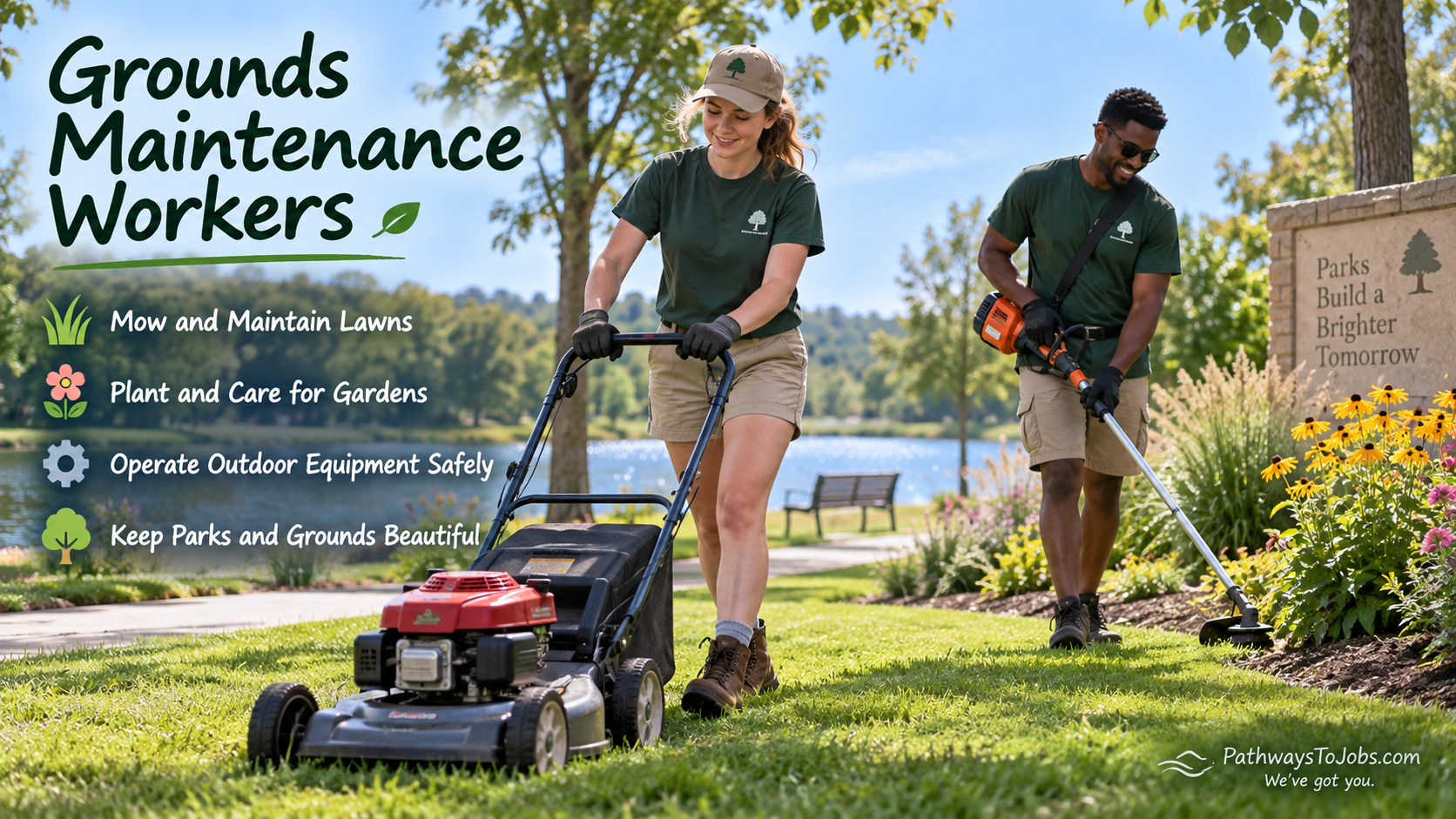
Grounds maintenance workers care for and maintain lawns, gardens, parks, sports fields, golf courses, and other outdoor spaces. Their work can include planting, mowing, pruning, watering, fertilizing, controlling weeds and pests, maintaining equipment, and keeping outdoor areas attractive, healthy, and safe.
Education
Grounds maintenance work usually does not require a formal post-secondary education. Some secondary-school education may be required, and much of the training is gained on the job. Courses or training in horticulture, landscaping, arboriculture, or equipment operation can be useful. Additional certification or licensing may be required for certain tasks, such as applying pesticides.
Work Environment
Grounds maintenance workers spend most of their time outdoors and work in a variety of weather conditions. The work can be physically active and may involve standing, walking, bending, kneeling, lifting, and operating landscaping equipment. Some positions are seasonal, while others include year-round work such as snow removal and property maintenance.
Future Outlook
People will continue to need well-maintained parks, gardens, sports fields, public spaces, residential properties, and commercial landscapes. Growing interest in attractive green spaces and outdoor environments can create ongoing opportunities for grounds maintenance workers. Experience can also lead to more specialized landscaping, horticulture, arboriculture, supervisory, or business opportunities. Current labour projections indicate continued demand for this work.
Recommended High School Courses
- Biology
- Math
- Communication
- Environmental Science
- Horticulture
- Physical education
- Operation and Control - Controlling operations of equipment or systems.
- Chemistry - Knowledge of the chemical composition, structure, and properties of substances and of the chemical processes and transformations that they undergo. This includes uses of chemicals and their interactions, danger signs, production techniques, and disposal methods.
- Customer and Personal Service - Knowledge of principles and processes for providing customer and personal services. This includes customer needs assessment, meeting quality standards for services, and evaluation of customer satisfaction.
- English Language - Knowledge of the structure and content of the English language including the meaning and spelling of words, rules of composition, and grammar.
- Arm-Hand Steadiness - The ability to keep your hand and arm steady while moving your arm or while holding your arm and hand in one position.
- Control Precision - The ability to quickly and repeatedly adjust the controls of a machine or a vehicle to exact positions.
- Extent Flexibility - The ability to bend, stretch, twist, or reach with your body, arms, and/or legs.
- Manual Dexterity - The ability to quickly move your hand, your hand together with your arm, or your two hands to grasp, manipulate, or assemble objects.
- Multilimb Coordination - The ability to coordinate two or more limbs (for example, two arms, two legs, or one leg and one arm) while sitting, standing, or lying down. It does not involve performing the activities while the whole body is in motion.
- Near Vision - The ability to see details at close range (within a few feet of the observer).
- Problem Sensitivity - The ability to tell when something is wrong or is likely to go wrong. It does not involve solving the problem, only recognizing there is a problem.
- Stamina - The ability to exert yourself physically over long periods of time without getting winded or out of breath.
- Static Strength - The ability to exert maximum muscle force to lift, push, pull, or carry objects.
- Trunk Strength - The ability to use your abdominal and lower back muscles to support part of the body repeatedly or continuously over time without 'giving out' or fatiguing.
- Visualization - The ability to imagine how something will look after it is moved around or when its parts are moved or rearranged.
- Dispose of trash or waste materials.
- Operate grounds maintenance equipment.
- Irrigate lawns, trees, or plants.
- Drive trucks or other vehicles to or at work sites.
- Trim trees or other vegetation.
- Prepare chemicals for work application.
- Treat greenery or surfaces with protective substances.
- Remove snow.
- Maintain equipment or systems to ensure proper functioning.
- Cultivate lawns, turf, or gardens.
- Evaluate reports or designs to determine work needs.
- Clean facilities or sites.
- Install equipment to protect or support trees.
- Plant greenery to improve landscape appearance.
- Remove debris from work sites.
- Decorate indoor or outdoor spaces.
- Provide information about landscaping services or costs.
Schools


Potential Scholarships
Approx Salary Expectation



References
Trend Analysis - Explorer the Market, Labour Market Information, Government of Canada https://www.jobbank.gc.ca/trend-analysis.
O*NET OnLine, National Center for O*NET Development, https://www.onetonline.org/.