Accounting Clerks
Accounting Clerks
Career Overview
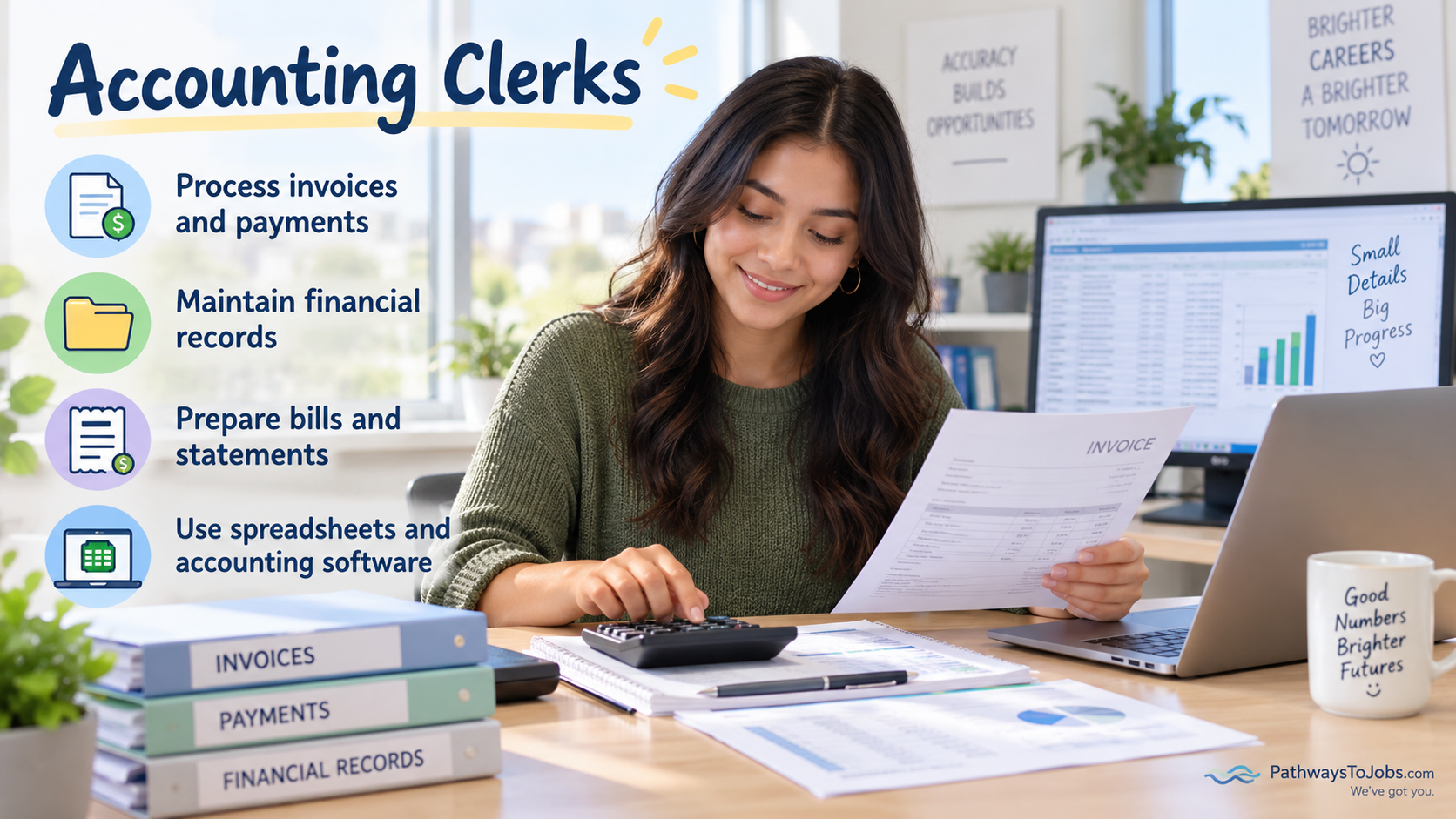
Accounting clerks maintain accurate financial records by recording transactions, processing invoices and payments, reconciling accounts, checking financial data, and supporting accounts payable, accounts receivable, billing, and bookkeeping tasks. They use accounting software, spreadsheets, and databases to organize and verify financial information.
Education
A high school diploma or equivalent can be enough to enter this career, although some employers prefer post-secondary coursework or training in accounting, bookkeeping, finance, or a related field. Strong skills in mathematics, spreadsheets, accounting software, organization, and attention to detail are valuable.
Work Environment
Accounting clerks generally work in offices and spend much of their time using computers and financial software. Most work full time, although longer hours can occur around financial reporting, tax periods, audits, or other deadlines.
Future Outlook
Accounting clerk work is increasingly supported by digital accounting software, spreadsheets, databases, and automated financial systems. Employment opportunities may vary by specialization and industry, while demand continues for workers who can accurately manage financial information, use accounting technology, and support organizations with day-to-day financial recordkeeping.
Recommended High School Courses
- Math
- Business
- Finance
- Economics
- Accounting
- Computer Applications
- Active Listening - Giving full attention to what other people are saying, taking time to understand the points being made, asking questions as appropriate, and not interrupting at inappropriate times.
- Critical Thinking - Using logic and reasoning to identify the strengths and weaknesses of alternative solutions, conclusions or approaches to problems.
- Mathematics - Using mathematics to solve problems.
- Monitoring - Monitoring/Assessing performance of yourself, other individuals, or organizations to make improvements or take corrective action.
- Reading Comprehension - Understanding written sentences and paragraphs in work related documents.
- Speaking - Talking to others to convey information effectively.
- Time Management - Managing one's own time and the time of others.
- Writing - Communicating effectively in writing as appropriate for the needs of the audience.
- Clerical - Knowledge of administrative and clerical procedures and systems such as word processing, managing files and records, stenography and transcription, designing forms, and other office procedures and terminology.
- Computers and Electronics - Knowledge of circuit boards, processors, chips, electronic equipment, and computer hardware and software, including applications and programming.
- Customer and Personal Service - Knowledge of principles and processes for providing customer and personal services. This includes customer needs assessment, meeting quality standards for services, and evaluation of customer satisfaction.
- Economics and Accounting - Knowledge of economic and accounting principles and practices, the financial markets, banking and the analysis and reporting of financial data.
- English Language - Knowledge of the structure and content of the English language including the meaning and spelling of words, rules of composition, and grammar.
- Mathematics - Knowledge of arithmetic, algebra, geometry, calculus, statistics, and their applications.
- Category Flexibility - The ability to generate or use different sets of rules for combining or grouping things in different ways.
- Deductive Reasoning - The ability to apply general rules to specific problems to produce answers that make sense.
- Inductive Reasoning - The ability to combine pieces of information to form general rules or conclusions (includes finding a relationship among seemingly unrelated events).
- Information Ordering - The ability to arrange things or actions in a certain order or pattern according to a specific rule or set of rules (e.g., patterns of numbers, letters, words, pictures, mathematical operations).
- Mathematical Reasoning - The ability to choose the right mathematical methods or formulas to solve a problem.
- Near Vision - The ability to see details at close range (within a few feet of the observer).
- Number Facility - The ability to add, subtract, multiply, or divide quickly and correctly.
- Oral Comprehension - The ability to listen to and understand information and ideas presented through spoken words and sentences.
- Oral Expression - The ability to communicate information and ideas in speaking so others will understand.
- Problem Sensitivity - The ability to tell when something is wrong or is likely to go wrong. It does not involve solving the problem, only recognizing there is a problem.
- Selective Attention - The ability to concentrate on a task over a period of time without being distracted.
- Speech Clarity - The ability to speak clearly so others can understand you.
- Speech Recognition - The ability to identify and understand the speech of another person.
- Written Comprehension - The ability to read and understand information and ideas presented in writing.
- Written Expression - The ability to communicate information and ideas in writing so others will understand.
- Maintain financial or account records.
- Operate computers or computerized equipment.
- Execute sales or other financial transactions.
- Verify accuracy of financial or transactional data.
- Compile data or documentation.
- Prepare cash for deposit or disbursement.
- Calculate financial data.
- Collect deposits, payments or fees.
- Operate office equipment.
- Reconcile records of sales or other financial transactions.
- Monitor financial information.
- Code data or other information.
- Answer telephones to direct calls or provide information.
- File documents or records.
- Search files, databases or reference materials to obtain needed information.
- Prepare documentation for contracts, transactions, or regulatory compliance.
- Calculate costs of goods or services.
- Maintain inventory records.
Schools


Potential Scholarships
Approx Salary Expectation
Related Careers



References
Trend Analysis - Explorer the Market, Labour Market Information, Government of Canada https://www.jobbank.gc.ca/trend-analysis.
O*NET OnLine, National Center for O*NET Development, https://www.onetonline.org/.