Nursery and Greenhouse Worker
Nursery and Greenhouse Worker
Career Overview
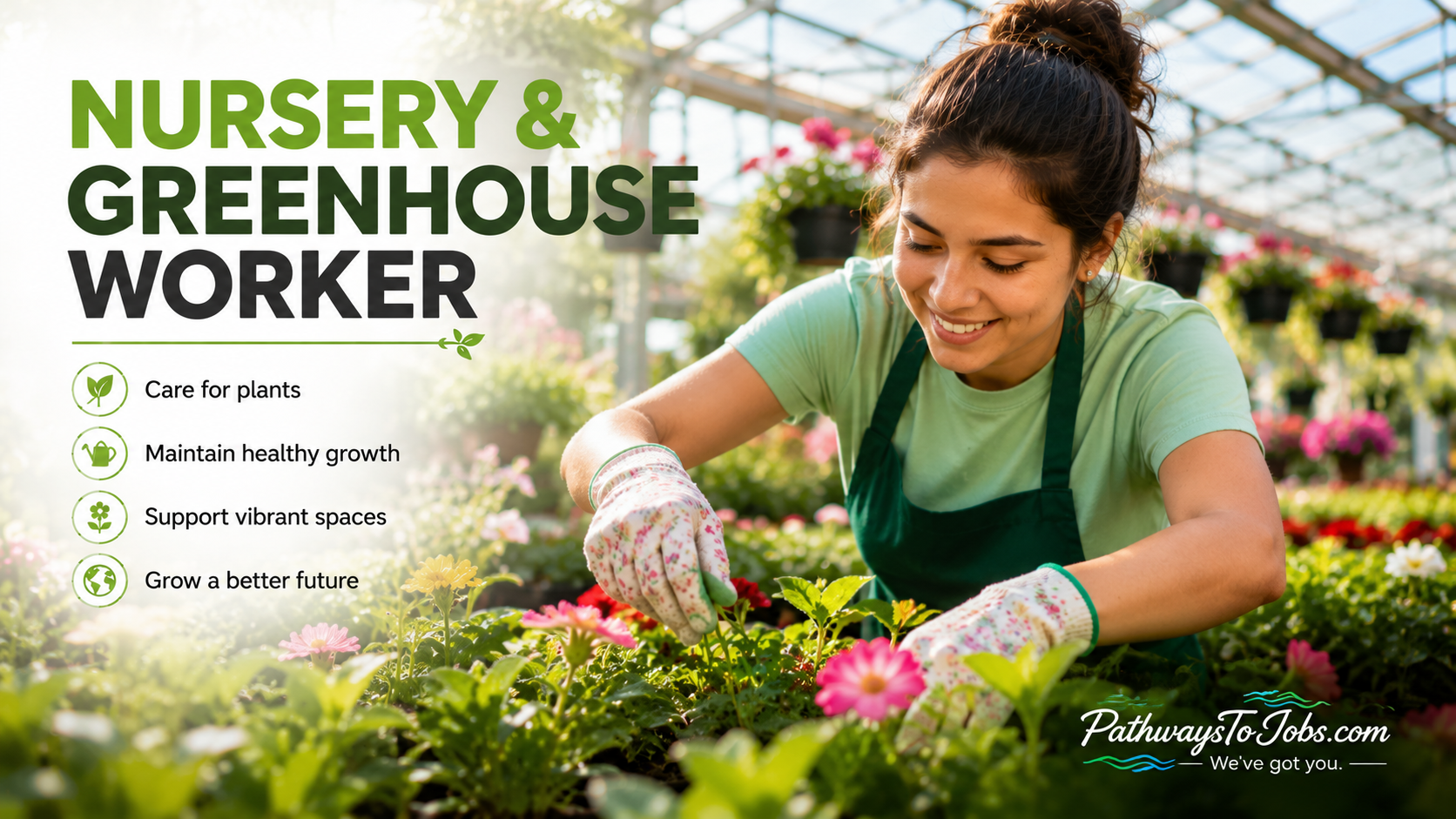
Nursery and Greenhouse Workers grow, care for, and maintain plants, trees, flowers, shrubs, and crops in nurseries, greenhouses, and garden centres. They plant, water, fertilize, prune, monitor plant health, prepare orders, and help ensure plants are healthy and ready for sale, landscaping, or agricultural use.
Education
Most Nursery and Greenhouse Worker positions require a high school diploma or equivalent, although some employers provide on-the-job training. Courses or certificates in horticulture, greenhouse production, agriculture, or landscaping can improve employment opportunities and career advancement.
Work Environment
Nursery and Greenhouse Workers spend most of their time outdoors or in greenhouses caring for plants. The work is physically active and may involve lifting, bending, standing for long periods, and working in a variety of weather conditions. Some positions are seasonal, while others are available year-round.
Future Outlook
Demand for Nursery and Greenhouse Workers is expected to remain steady as landscaping, food production, greenhouse operations, and environmental restoration continue to grow. Opportunities are available with nurseries, greenhouses, garden centres, landscaping companies, municipalities, and commercial growers.
Recommended High School Courses
- Biology
- Computer Applications
- Agricultural Science
- Horticulture
- Mathematics
- Geography
- Arm-Hand Steadiness - The ability to keep your hand and arm steady while moving your arm or while holding your arm and hand in one position.
- Category Flexibility - The ability to generate or use different sets of rules for combining or grouping things in different ways.
- Dynamic Strength - The ability to exert muscle force repeatedly or continuously over time. This involves muscular endurance and resistance to muscle fatigue.
- Extent Flexibility - The ability to bend, stretch, twist, or reach with your body, arms, and/or legs.
- Far Vision - The ability to see details at a distance.
- Finger Dexterity - The ability to make precisely coordinated movements of the fingers of one or both hands to grasp, manipulate, or assemble very small objects.
- Flexibility of Closure - The ability to identify or detect a known pattern (a figure, object, word, or sound) that is hidden in other distracting material.
- Information Ordering - The ability to arrange things or actions in a certain order or pattern according to a specific rule or set of rules (e.g., patterns of numbers, letters, words, pictures, mathematical operations).
- Manual Dexterity - The ability to quickly move your hand, your hand together with your arm, or your two hands to grasp, manipulate, or assemble objects.
- Multilimb Coordination - The ability to coordinate two or more limbs (for example, two arms, two legs, or one leg and one arm) while sitting, standing, or lying down. It does not involve performing the activities while the whole body is in motion.
- Near Vision - The ability to see details at close range (within a few feet of the observer).
- Oral Comprehension - The ability to listen to and understand information and ideas presented through spoken words and sentences.
- Oral Expression - The ability to communicate information and ideas in speaking so others will understand.
- Speech Recognition - The ability to identify and understand the speech of another person.
- Stamina - The ability to exert yourself physically over long periods of time without getting winded or out of breath.
- Static Strength - The ability to exert maximum muscle force to lift, push, pull, or carry objects.
- Trunk Strength - The ability to use your abdominal and lower back muscles to support part of the body repeatedly or continuously over time without 'giving out' or fatiguing.
- Plant crops, trees, or other plants.
- Apply chemical solutions to plants to protect against disease or insects or to enhance growth.
- Transport animals, crops, or equipment.
- Sell agricultural products.
- Harvest agricultural products.
- Mark agricultural or forestry products for identification.
- Operate irrigation systems.
- Package agricultural products for shipment or further processing.
- Evaluate quality of plants or crops.
- Advise others on farming or forestry operations, regulations, or equipment.
- Build agricultural structures.
- Cut trees or logs.
- Maintain inventories of materials, equipment, or products.
- Maintain operational records.
- Prepare land for agricultural use.
- Capture or kill animals.
- Clean equipment or facilities.
- Operate farming equipment.
Schools


Potential Scholarships
Approx Salary Expectation
Related Careers
References
Trend Analysis - Explorer the Market, Labour Market Information, Government of Canada https://www.jobbank.gc.ca/trend-analysis.
O*NET OnLine, National Center for O*NET Development, https://www.onetonline.org/.